
IELTS Preparation Courses Dos and Don’ts for Exam Success
International Exams
IELTS Preparation: Dos and Don’ts for Exam Success
Posted 29 April 2026
So you’ve decided to take the IELTS exam and you want to do a preparatory course. Good choice!
IELTS is one of the most widely recognised English language tests in the world. It can help you progress to university, improve your career prospects, apply for professional registration or move to an English-speaking country. But once you have made the decision to take the exam, the next question is usually the same for everyone:
How do I prepare for IELTS properly?
Hopefully this post will help you make some good decisions and avoid some common mistakes while you’re choosing an IELTS course, preparing for the exam and on the actual day you take it! This is the advice that we give to all our students who choose to take the IELTS exam in Galway.
Before choosing your IELTS course
Do your research
If you want to study for the IELTS in Ireland or anywhere else in the world, you should make sure that the course you’re taking is right for you.
A lot of people come to learn English in Ireland, but not all courses will show you how to prepare for IELTS. Every exam is different, and even with all the great resources available to students online, nothing beats preparing with a teacher who really understands how the exam works and what is expected of you.
Make sure that the course you take will help you with every skill and that you will be able to easily book and take the exam somewhere near your accommodation so that you’ll be well rested and relaxed on the day.
A good IELTS preparation course should help you:
- Understand the IELTS exam format
- Practise reading, writing, listening and speaking
- Learn useful exam strategies
- Improve your academic vocabulary and grammar
- Receive feedback from experienced teachers
- Practise under timed exam conditions
- Build confidence before test day
There’s also something about safety in numbers. It’s nice to be on a preparation course where you’re going through the process together, and where you can also spend time with your classmates practising your English and helping each other out.
Do check which IELTS test you need
Before you begin preparing, make sure you know which version of IELTS you need. There are two main IELTS tests:
IELTS Academic is usually required if you want to study at undergraduate or postgraduate level, or if you need English for professional registration.
IELTS General Training is usually used for migration, work or training below degree level.
The Listening and Speaking sections are the same in both tests, but the Reading and Writing sections are different, so it is important to prepare for the correct one.
If you are taking IELTS for university, immigration or professional registration, always check the exact score and test type required by the organisation you are applying to. Requirements can vary, and it is your responsibility to confirm them before booking your exam.
Don’t choose a course only because it is convenient
It can be tempting to choose the cheapest course, the nearest course or the one with the easiest timetable. Of course, practical details matter. You need a course that fits your dates, your budget and your accommodation plans.
But don’t forget the most important question: Will this course actually help me prepare for IELTS?
That might sound obvious, but some courses with the IELTS preparation label consist of a combination of general English classes in the mornings, with maybe just a few hours of specific IELTS focus in the afternoons. Instead, we recommend you look for a school that offers structured exam preparation for all of the weekly hours of classroom time. On top of that, make sure you check that the school has experienced teachers and opportunities to get personal support if you need it.
Galway Cultural Institute has been providing English language education since 1989 and welcomes students from more than 30 countries each year. GCI is based in Salthill, Galway, overlooking the Atlantic Ocean, and operates as the English language education division of Galway Business School.
During your IELTS course
Do get to know the marking system
If you want to improve your IELTS score, you need to understand how IELTS is marked.
As a student, you should set meaningful and achievable goals for yourself and then share those goals with your teacher.
Find out which skills (reading, writing, listening or speaking) you are strongest in and which ones need the most improvement. Especially with writing and speaking, there are very specific things the examiners are looking for and you will be better able to meet your goals if you understand the requirements clearly.
IELTS is scored from 1 to 9 in each part of the test: listening, reading, writing and speaking. There is no simple pass or fail. Instead, your results show your level of English across the four skills.
Do you need an overall 6.0? A 6.5? A 7.0? Do you need a specific score in Writing or Speaking? Some universities and professional bodies require a particular score in each skill, not just an overall band score.
Share your goals with your teacher. They can help you understand:
- Which skills are already strong
- Which skills need more attention
- What kind of mistakes are affecting your score
- How to improve your writing and speaking performance
- How to study more effectively outside class
Writing and Speaking are especially important because there are very specific things examiners are looking for. You will do much better if you understand the criteria clearly and practise using your teacher’s feedback.
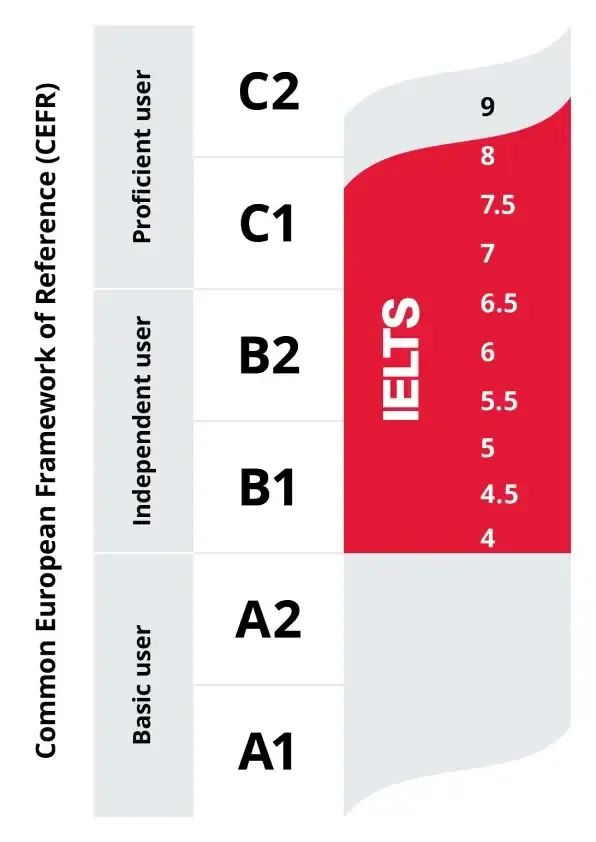
CEFR To IELTS Band Score Comparison, Source: https://ielts.org/
Don’t ignore your teacher’s advice
This sounds simple, but it is one of the most important IELTS tips.
Throughout your course, listen to your teacher’s feedback. Whenever they correct something in your writing or speaking, try to understand why you need to make an improvement and think about that the next time you do a task.
Many IELTS teachers in Galway find their advice falling on deaf ears. Make sure you’re one of the students who takes full advantage of having access to a good teacher.
Here we look carefully at what the examiners want from our students and try to steer them in the right direction. The coursebooks used in classes are carefully written to contain the correct and relevant IELTS preparation course content that will help you the most. Trust your teacher and take everything you do in class seriously, even if it’s not always exam practice. There are more ways to improve your skills than just by doing practice tests.
At GCI, our teachers look carefully at what IELTS candidates need and guide students towards better exam performance. The course materials, classroom tasks and homework are designed to support your preparation, even when the lesson does not look like a full practice test.
Remember: there are many ways to improve your IELTS score. Practice tests are useful, but they are not enough on their own.
Do practise all four IELTS skills
The IELTS exam tests reading, writing, listening and speaking. You may naturally prefer one skill, but you cannot afford to ignore the others.
Many students spend a lot of time on reading and listening because they can practise these skills alone. But writing and speaking often need more feedback.
You need someone to show you where your answer is unclear, where your structure is weak or where your language is not accurate enough.
During your IELTS preparation course, try to balance your study time, for example:
- Read articles, reports and academic texts
- Listen to podcasts, lectures and interviews
- Practise speaking on unfamiliar topics
- Write essays, reports, letters or summaries depending on your test type
- Review grammar and vocabulary in context
- Learn how to plan before you write
- Record yourself speaking and listen back
The more you practise in a realistic way, the more confident you will feel on the day of the exam.
Do think about time
IELTS is not only a language test. It is also a test of time management.
As with all exam preparation, time is very important. The IELTS exam is very time sensitive and your teacher will help you manage your time, but you should think about it as well. You need to think about the limited time you’ll have on the day of the test; and the best way to prepare for this is to start timing your homework. Try to do some of the tasks you’re assigned the way you will on the test: no phone, no distractions, within the time limit.
Homework and study time outside of the class are essential.
You need to organise in the long term as well. Think about how many weeks you have before the test, what skills you want to work on, and how much you want to do each night. The more work you do in your first two weeks of the course, the less stressed you’ll feel when you reach the end.
The listening, reading and writing sections are usually taken on the same day, with no breaks between them. The speaking test may take place on the same day, or up to seven days before or after, depending on local arrangements. That means you need to practise working under pressure.
Start timing your homework. Try some tasks the way you will do them in the exam:
- No phone
- No dictionary
- No distractions
- No extra time
- No checking the answer halfway through
This will help you understand your real exam speed.
If you always practise slowly and comfortably, the real test can feel stressful. But if you train yourself to work within the time limit, you will be much calmer when it matters.
But don’t overdo it
Having just given you a big to-do list, be careful that you don’t overwhelm yourself or make the experience more stressful than it needs to be. This is another good reason for studying in a language school, because we can help keep everything in balance for you, and you can come and speak to us if you’re feeling stressed.
If you’re doing your IELTS course in Ireland, away from home, make sure you take good care of yourself. Talk to your friends and family regularly and find some fun things to do with friends outside of your preparation course. Sleep properly. Eat well. Spend time with classmates. Go for a walk. Explore Galway!
Remember: we offer an exciting activities programme for our students so every time you go out and do something fun while speaking in English, you’re still studying!
Don’t only study by doing exam tasks. Read magazines and books in English, watch films and series to work on your listening, and speak as much as you can about as many topics as you can. Studying doesn’t have to be tiring and stressful.
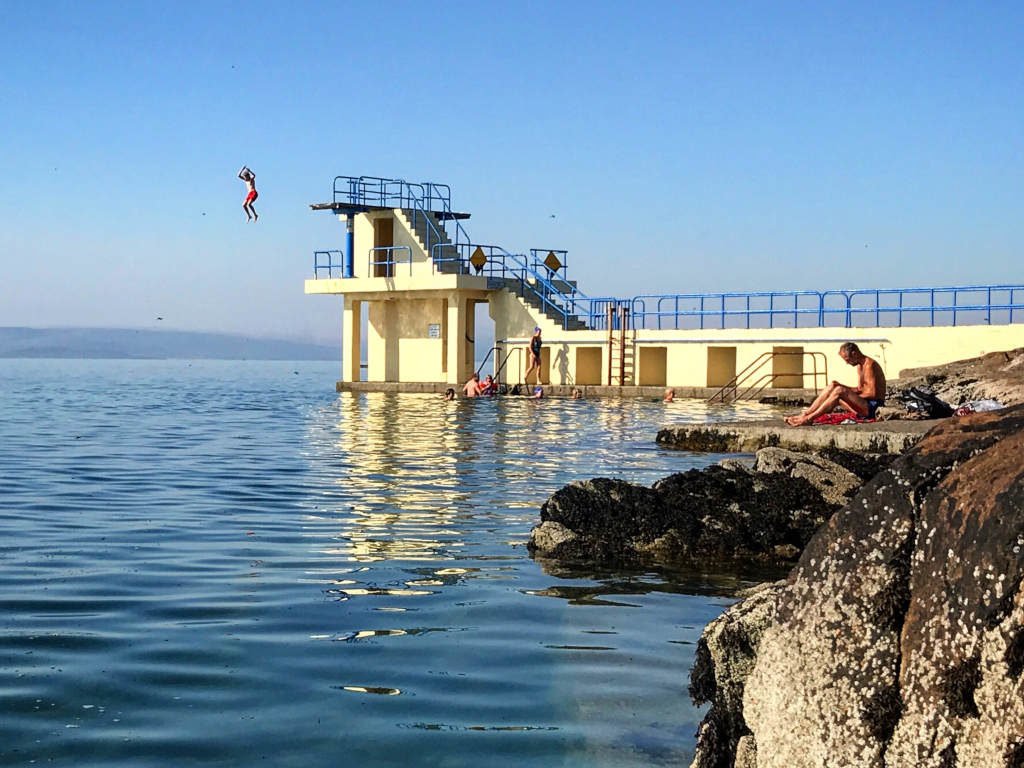
Walk the Prom in Salthill or even take a swim in the Atlantic Ocean
On the day of the exam
Do read the instructions carefully
The IELTS exam has so many different task types that it is easy for even the best prepared student to make a mistake. So, on the day of the test, read the tasks and make sure that if they ask you for two correct answers you don’t select just one and that if they ask you to fill a gap with no more than two words you don’t write three. If it asks you to choose from a list, check exactly how many options you need.
This may sound obvious, but under pressure it is easy to make small mistakes.
Take a few seconds to read each instruction carefully before you answer. Those few seconds can protect your score.
Don’t spend too long on one question
Remember that you’re working against the clock, especially in reading and writing.
While you’ve been preparing for the exam, you have developed techniques for dealing with the time limits. Don’t allow yourself to panic and forget all this important work on the day. When you come across a question you don’t have a good answer to: take a deep breath, write something down and put a star next to it on your question paper. If you have time at the end, you can come back to it.
This is why timed practice during your course is so useful. By the time you reach test day, you should already know how to keep moving.
Don’t be afraid to be yourself
When you’ve been preparing for an exam for weeks or even months, it can be very easy to become a little obsessed with passing, with linkers, better vocabulary and avoiding mistakes until you forget that the examiners want to hear you communicate! But remember: IELTS is a communication test. In the speaking exam, the examiner wants to hear how well you can communicate.
That is much easier when you have something genuine to say.
You’re a brave person. Maybe you’ve already chosen to do your IELTS preparation in Ireland, away from home, let the examiner see that!
Let your personality come through.
Be clear. Be organised. Be accurate where you can. But don’t forget to communicate.
Book now
If you want to prepare for IELTS successfully, remember these key points:
Choose the right course. Understand the test. Listen to your teacher. Practise regularly. Manage your time. Look after yourself. Read the instructions carefully.
And, when it comes to speaking, don’t be afraid to be yourself.
IELTS preparation takes effort, but you do not have to do it alone.
At Galway Cultural Institute, our teachers and support team are here to help you build your skills, grow in confidence and move closer to your next academic or professional goal.
Explore our IELTS preparation courses in Galway and start planning your next step.
Explore our IELTS courses
Book nowIELTS FAQs
What is the best way to prepare for IELTS?
The best way to prepare for IELTS is to understand the exam format, practise all four skills, study under timed conditions and get regular feedback from an experienced teacher. A structured IELTS preparation course can help you focus on the skills and strategies you need most.
Can I study for the IELTS in Ireland?
Yes. You can study IELTS in Ireland at English language schools such as Galway Cultural Institute. Studying in Ireland gives you the opportunity to prepare for the exam while practising English every day in real-life situations.
Why should I take an IELTS preparation course?
An IELTS preparation course helps you understand the exam structure, marking criteria, question types and time limits. It also gives you feedback on your writing and speaking, which can be difficult to improve through self-study alone.
What level of English do I need for an IELTS preparation course at GCI?
GCI’s IELTS preparation course is suitable for students at Intermediate B1 level or higher. Students should check the latest course details before booking, as entry requirements and start dates may change.
Is IELTS Academic different from IELTS General Training?
Yes. IELTS Academic is usually used for university study and professional registration, while IELTS General Training is usually used for migration, work or training below degree level. The listening and speaking sections are the same, but the reading and writing sections are different.
How long does it take to prepare for IELTS?
The time needed depends on your current English level, your target score and how much study you can do each week. A structured course can help you use your preparation time more effectively and focus on the areas that need the most improvement.
Is Galway a good place to prepare for IELTS?
Yes. Galway is a welcoming student city on Ireland’s west coast. It offers an English-speaking environment, a lively cultural scene and many opportunities to practise English outside class.